
STUDENT PROTESTS ARE NOTHING NEW
But This Year They Are Different

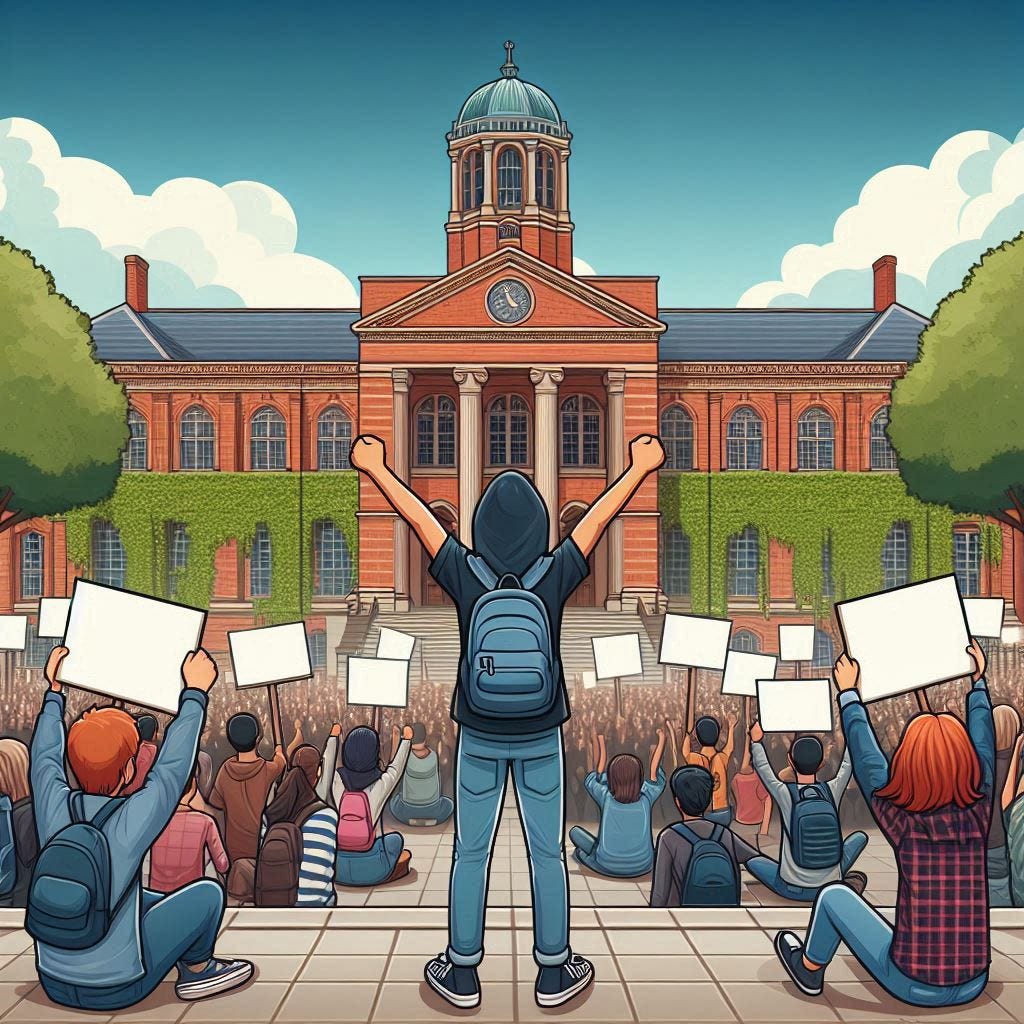
The news this week has been dominated by coverage of the student protests that erupted on college campuses across the United States. Such events have been occurring at the end of the school year for decades — a Spring ritual celebrating the anticipation of freedom from the academic grind and the transition to Summer fun. But this year the protests feel different, as if they have taken a darker and more ominous turn. They seem to be more coordinated across the country, more overtly political, and more violently suppressed.
When I was a student at the University of Massachusetts in Amherst in the 1960s, similar protests erupted every Spring against the Viet Nam war. Like today’s students, we rebelled against the United States’ involvement in somebody else’s war. We were less concerned about the innocent victims of that conflict, though, than we were about the prospect of being sent to fight against our will and returning in a body bag, or not returning at all. Our protests were more spontaneous and always ended by sundown.
We didn’t set up camp in expensive tents with lavish camping gear. We didn’t make demands against the school administration. But we did drink a lot of beer and make a lot of noise. Those protests were not coordinated with other campuses around the country across social media sites on the internet because personal computers, cell phones, and the internet had not been invented yet. And, while the campus police did their best to contain any violence, they never called in the National Guard or met our hooliganism with a phalanx of heavily armed anti-riot teams.
This year’s protests are very different. The similarities in messaging, actions, and timing on key campuses across the country clearly point to coordination by one or more organizations that feels it would benefit by such unrest. And the unusual number of non-student participants at all of the protests reinforces the suspicion that they were driven as much by political operatives than by simple exuberance and Spring fever. It is apparent that they were at least partly fueled by forces that want college students to appear elitist and antisemitic, college administrators to look weak, and the Biden administration to seem to be on the wrong side of the Palestinian conflict.
Will the college protests affect the November election? I don’t think so. Students today are much more engaged and better-informed than we were in the 1960s. They recognize that the team of Blinken and Biden has been working tirelessly to reach a diplomatic resolution to the Hamas/Israeli dispute and stop the brutal displacement and killing of Palestinians in Gaza. They also recognize that if Trump were to be reelected, he would fully support Netanyahu’s campaign to take over the Gaza strip. And, just as the protests have been an end of term diversion for college students, they have also been a diversion from the Trump trial for voters.
Even without the college protests, the over-reaction of Israel’s authoritarian government to the brutal Hamas attacks that incited their war on all Gazans, has left support for Israel within the United States weaker now than it has ever been. If Netanyahu and his extreme right-wing coalition remain in power, they are likely to lose the massive financial and military support that Israel has been getting from us since 1949. Unless, of course, Trump returns to power and joins their drive to wipe out the Palestinians and take over not only Gaza but also the West Bank. If, on the other hand, the Biden administration remains in office and the Israelis oust Netanyahu, there is a real possibility that Israel could move toward acceptance of the Palestinian presence in the territory they captured over the years and rebuild its reputation and close partnership with the United States.
(A.I. cartoon of student protest generated by Microsoft Copilot)
Postscript
I write my blogs early in the week, then refine them every day until posting on Friday. I wrote this one on Tuesday. Last night, historian Heather Cox Richardson posted a lengthy commentary on Substack that not only solidly reinforces what I wrote, but also names names and details motivations of the people behind the conspiracy I hinted at. You can read Heather’s analysis at Letters From an American on Substack.com.